Private, non-commercial project — for personal use only, not a product or service offered to the public.
Observe · Validate · Execute · Review

The trading engine that
shows its work.

Falconn trades NIFTY systematically and records every decision it makes — each signal stamped with the rule that produced it, every session replayable tick by tick, every loss classified.

One traceable loop — the bench stays separate from the money.
desk.falconn.app — Performance SYSTEM · TRADING
Monitor
Ops
Positions
Analytics
Review
Performance
Journal
Charts
Replay
Research
Research
Strategies
Workbench
Net P&L (validation)
₹5.61L
Trades
106
Win rate
48%
Max drawdown
₹15.3k
₹0₹2L₹4LJul 25Jan 26Jul 26
Cumulative P&L per trade — three forward-validation runs · 106 trades · Jan 2025 → Aug 2026 · net of costs · not live performance · methodology ↓
Latest decisions
NIFTY 24500 CE +38.2
STRAT_003 · rule R3.2 · 6 lots
Signal — STRAT_006
vetoed: low-volatility regime
Stop trailed 24 481 → 24 512
100%
of decisions recorded & traceable
8
strategies forward-validated before going live
Tick
level session replay, print by print
1-click
halt — hard risk limits enforced in code
The platform

Six rooms, one process

Everything the engine does lives on one desk — from the live session to the research bench.

Automated Journal

Every signal, order, fill and exit is journaled as it happens — nothing typed in after the fact, nothing forgotten.

Market Replay

Play any archived session back print by print and watch exactly what the engine saw when it pulled the trigger.

Research bench

Walk-forward folds, parameter sweeps and a stored run history — every experiment keeps its id, so a claim can be re-opened later.

Failure-mode analysis

Losses are classified, not mourned: false breakout, weak entry, low-vol regime — with the why on every trade.

Performance

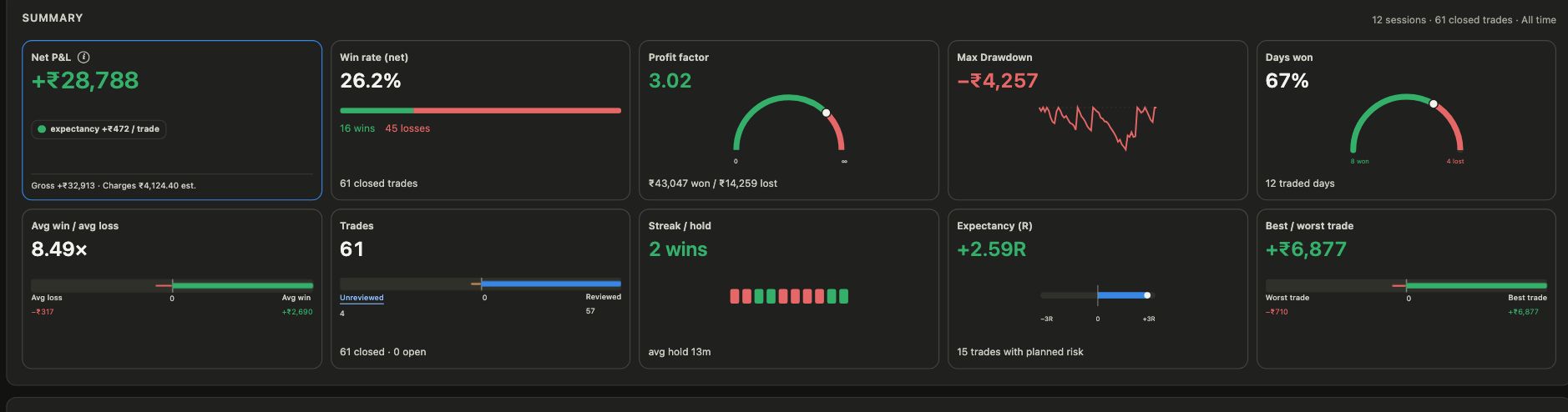
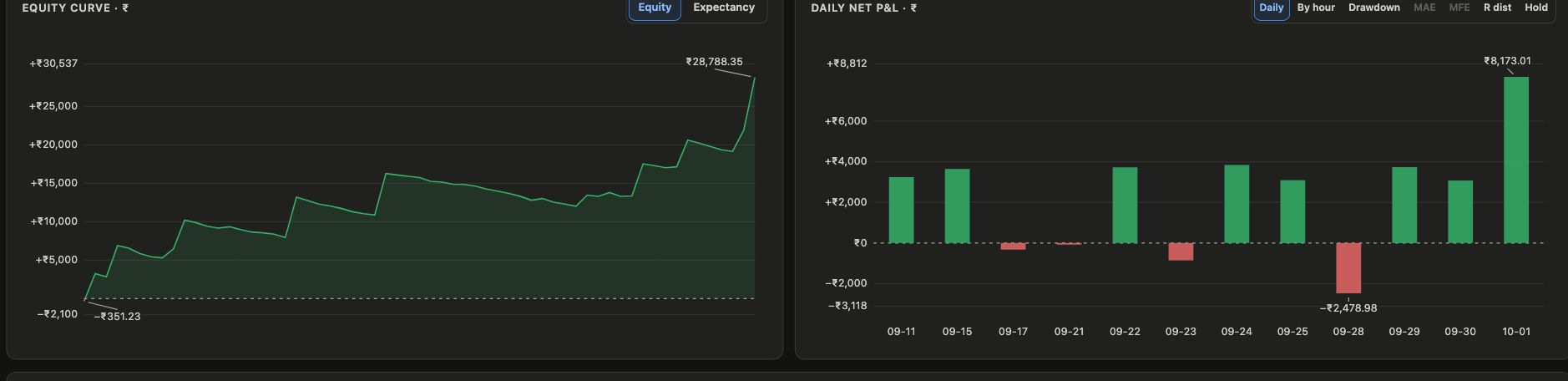
Session-over-session equity, R-multiples, MAE/MFE excursions and exit-reason attribution across every arm.

Risk guardrails

Hard order caps, daily loss budgets and per-class position limits, enforced before an order is sent — discipline in code, not willpower.

Journal

Every decision, stamped and searchable

The journal writes itself while the engine trades. Each entry carries the exact rule and structure that produced it — so weeks later, one click answers "why did we take this?"

  • Signal → decision → execution → outcome, on one card
  • Structure and rule ids captured as the trade happens
  • R-multiple, MAE/MFE and slippage computed for you
  • Notes, tags and grades for the human layer
Trade detail — NIFTY 24500 CE12 Aug · 09:47
StructureHH → HL → breakout
StrategySTRAT_003 · v17
Entry / Stop ruleR3.2 / S2.1
Fill vs signal+0.8 pt
Outcome+1.21R · MFE +1.63R
REPLAY DECISION →
Replay

Rewind the market. Watch the decision.

Any archived session plays back print by print, on its own clock — and every trade in the journal deep-links to the exact moment its signal armed.

desk.falconn.app — Market Replay 14 AUG · 1×
Monitor
Ops
Positions
Analytics
Review
Performance
Journal
Charts
Replay
Research
Research
Strategies
Workbench
13:35
13:35 → 13:55 · 5-min · tick by tick
This session
09:47:03 fill
NIFTY 24500 CE · 6 lots · STRAT_003
10:12:20
stop trailed 24 481 → 24 512
11:04:55
signal vetoed — low-volatility regime
13:41:05
stop trailed 24 512 → 24 536
13:52:40 +38.2
exit — structural trailing stop
Tick-level tape, not just candles Pan and zoom mid-playback Deep-linked from the journal The data the engine actually saw
Research

Losses become lessons, automatically

The bench runs backtests and forward validation on sessions the strategy has never seen — and when live trades lose, a deterministic classifier explains how: the taxonomy your next improvement comes from.

  • Every losing trade tagged with a failure mode
  • A deterministic classifier — the same loss reads the same way twice
  • Patterns surface across trades, not one at a time
  • The taxonomy is where the next strategy version starts
Failure modes — last 90 days21 losses
False breakout 38%
Weak / late entry 24%
Low-volatility regime 19%
Time-exit loss 14%
Execution / slippage 5%
deterministic classifier · rolling 90 sessions21 of 21 classified
The process

An idea doesn't become a position until it survives four gates

Most of this system exists to answer one question honestly: is this edge real, or was it fitted to the past? Each gate needs the run that justified it — a reference, not an opinion.

1
Draft

Hypothesis

A rule written against the strategy schema, versioned from the moment it exists.

Owner recorded
2
In-sample

Backtest & sweep

Historical candles, walk-forward folds and parameter grids — net of real costs, never gross.

Needs a run id
3
Frozen

Forward paper

Parameters locked, replayed forward on sessions that did not exist when it was tuned.

Months, not days
4
Live

Real capital

Only once the pre-committed bar is cleared — and only with an out-of-band confirmation.

Two-key release

A strategy that fails a gate goes back, not forward. There is no override on the promotion path, and every transition is written to an audit log with the actor's name against it.

Pre-commitment

The bar is set before the result

The usual way a thin edge reaches real money is that the target moves — someone looks at six encouraging weeks and decides six weeks was always enough. So the numbers are fixed first, per strategy, alongside the abort triggers that shelve it.

  • Development cutoff recorded per strategy
  • Everything after that date is out-of-sample by definition
  • Abort triggers named while the outcome is unknown
  • Nothing before the cutoff counts toward the bar
Go-live criteria — pre-registeredfrozen
CriterionBarActual 
Forward sessions≥ 6074pass
Out-of-sample trades≥ 3041pass
Profit factor, net≥ 1.251.38pass
Max drawdown≤ 8.0R5.2Rpass
Parity divergences00pass
Parameters changed00pass
STRAT_002_LONG · cutoff 2026-06-18bar frozen before evaluation
Forward ledgers — parity statusnightly
LedgerForwardTradesParity
STRAT_002_LONG41clean
STRAT_010_LONG28clean
STRAT_006_SHORT17held
STRAT_007_PEAK9held
STRAT_011_SHORT33clean
STRAT_001_LONG22clean
STRAT_012_SHORT14clean
STRAT_006_LONG19clean
last accrual 19 Aug 19:22 IST8 ledgers · 2 held
Parity

If paper and backtest disagree, the ledger doesn't count

Every forward trade is diffed against the backtest engine that proposed the edge. A mismatch isn't noise to be averaged away — it means one of the two is wrong, and until that's explained the ledger isn't evidence.

  • Divergences alert nightly, with the trade named
  • A held ledger is disqualified from go-live decisions
  • Held is the system working, not the system failing
  • It returns to evidence only once root-caused
Provenance

Every fill knows which rule produced it

Strategies are versioned records, not settings edited in place. Each trade is stamped with the strategy, the version and a hash of the exact definition that was live at that moment — so a trade from months ago still traces to the logic that placed it, character for character.

  • Editing a live strategy isn't possible — a change is a new version
  • A new version walks the same four gates again
  • Rejected and vetoed signals are recorded with their reason
  • "Why didn't it fire?" is an answerable question
Trade stampimmutable
strategy_idSTRAT_002_LONG
version4of 6
definition_hash9f3c1d…a71ecopy
promoted_byprashant
promoted_at2026-07-14 18:02 IST
paper_refsim_2026-07-14_a3open
fill 12 Aug 2026 · 09:47:03.412 ISTimmutable
Built to fail safely

The interesting failures aren't losing trades

They're the pod restarting mid-position, the stop that never got placed, the feed going quiet at 11:04. Most of the engineering here is about those.

Position reconciliation

Every restart reconciles against the broker's own truth before trading resumes — and refuses to start with an unprotected live position.

Stop coverage, continuously

Protective-stop coverage is re-checked on a schedule, never assumed from the moment an order was accepted.

Scale sanity

A stop is validated against the instrument it belongs to, so a futures level can never reach an option order.

Staleness watchdog

A feed that goes quiet is treated as a fault, not as a market that happens to have no ticks in it.

Typed confirmations

Risk-increasing actions make the operator type the thing back. Risk-reducing ones stay frictionless — and both are audited.

Your infrastructure

Self-hosted end to end. Strategy logic and trade history never leave the cluster, and no vendor's shutdown becomes your problem.

One decision, end to end

Every trade travels the same traceable path

Recorded at every step. Reviewable forever. Replayable from signal to fill.

1
Market
live ticks
2
Structure
highs · lows · breaks
3
Strategy
validated rule fires
4
Risk
limits & sizing
5
Order
placed
6
Fill
executed
7
Outcome
R · MAE · MFE · logged
and it closes failure classificationresearchnew strategy versionvalidationlive
FAQ

Straight answers

Can I use Falconn?

Not today. Falconn is a private, non-commercial project — one person's engine, trading one account. This site exists to document the work, not to sell it.

Is any of this investment advice?

No. Nothing here is a recommendation, signal, or solicitation. Figures in interface illustrations are sample data, historical market data, or research/validation results — not live performance.

What does "forward-validated" mean?

A strategy is frozen, then evaluated on sessions it has never seen — the third of the four gates above. Only strategies that hold up on that unseen data become eligible to place live orders.

How were the validation figures produced?

The equity curve and stats combine three research-bench runs over Jan 2025 → Aug 2026 — 106 trades, merged in exit order, no trades removed. Sizing follows the same risk rules the live engine uses (NIFTY lot size 65). The three runs are not a selection from a larger pool — they are the three strategies that passed forward validation and earned live eligibility, shown in full. P&L is as reported by the research runner with transaction costs and slippage included. Validation windows are frozen before evaluation and strategies are not modified during a run. These are research results on historical and unseen forward sessions — not live trading.

Why publish a site for a private system?

Accountability and craft. Writing the system down — honestly, including how it loses — keeps the engineering disciplined.

Get in touch

Falconn is a private project — but questions and conversations are welcome. Leave a note and we'll get back to you.

hello@falconn.app
Built on structure.
We'll only use your details to reply. No spam, no lists.